
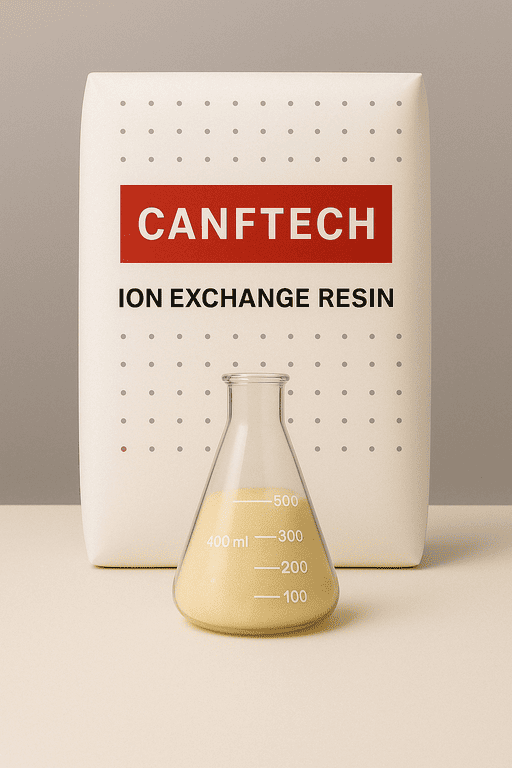
Description
Canftech AD120 is a sort of non-polar styrene series macroporous absorbent resin. It is used mainly to separate and extract cephalosporin, polyphenol, saponin, anthocyanin, colchicine, paclitaxe, vitamin E, ellagitannin and pleocidin.
Saponin Separation with Canftech AD120
Canftech AD120 is a non-polar styrene-based macroporous adsorbent and is one of the best-suited resins in the Canftech range for saponin separation. Saponins are amphiphilic molecules: they have a hydrophobic core (the aglycone) and highly hydrophilic sugar chains. The non-polar AD120 matrix binds the hydrophobic aglycone strongly, while the sugar chains stay solvated in the aqueous phase. This makes it possible to load saponins from water, wash impurities away, and then release the saponins selectively with aqueous ethanol.
AD120 vs AD110 for saponins
| Feature | Canftech AD110 | Canftech AD120 |
|---|---|---|
| Matrix / polarity | Aromatic macroporous adsorbent with styrene framework; selectively adsorbs specific organics from aqueous solution. | Non-polar styrene-series macroporous adsorbent, designed for non-polar and weakly polar natural compounds. |
| Main applications | Cephalosporin and other antibiotics, large organic molecules in industrial wastewater, syrup and fructose production from fruit juices. | Cephalosporin, polyphenols, saponins, anthocyanins, colchicine, paclitaxel, vitamin E, ellagitannin and pleocidin. |
| Specific surface area | 600–800 m²/g | ≥ 800 m²/g (more binding sites) |
| Water retention | 55–65 % | 55–65 % |
| Saponin elution | Possible with aqueous ethanol, but saponins are not a listed target application. | Water and low-% ethanol washes, then 70–80 % ethanol to recover the saponins (protocol below). |
Our recommendation: use AD120 for saponin separation. Its non-polar matrix, higher surface area and explicit saponin application give better binding capacity, recovery and purity than AD110.
Choice of eluent: 70–80 % ethanol (v/v)
Pure water does not elute saponins, because the aglycone stays tightly bound to the non-polar resin. Pure ethanol or methanol can work, but an ethanol–water mixture of 70–80 % gives the best balance: it is polar enough to solvate the sugar chains and contains enough organic solvent to break the hydrophobic interaction between the aglycone and the resin.
Safety note: ethanol is preferred over methanol for large-scale natural product extraction because of its low toxicity, which also makes it the better choice for food and pharmaceutical applications.
Step-by-step column protocol
Crude extract
▼
Load onto AD120 column (in water or low-% ethanol)
▼
Wash with water (sugars, salts, highly polar impurities)
▼
Wash with 10–30 % ethanol (mildly polar impurities; saponins stay bound)
▼
Elute saponins with 70–80 % ethanol and collect fractions
- Prepare and load the extract. Dissolve the crude saponin extract in water or a low ethanol concentration (e.g. 10 %). Load it onto the AD120 column slowly, at a low flow rate, for maximum adsorption.
- Wash the column (crucial). Wash with 3–5 column volumes (CV) of pure water to remove free sugars, proteins and other highly polar impurities. Optionally, wash with 1–2 CV of 10–30 % ethanol to remove less polar impurities such as some flavonoids or pigments while the saponins remain bound.
- Elute the saponins. Apply 3–5 CV of 70–80 % ethanol and collect the eluate in fractions. Saponins produce a persistent, soap-like foam when a fraction is shaken with water, so a simple foam test shows where they elute; TLC or HPLC gives a precise saponin profile.
- Concentrate and dry. Combine the saponin-containing fractions and remove the ethanol on a rotary evaporator under reduced pressure, typically below 50 °C to protect heat-sensitive saponins. Freeze-dry the remaining aqueous solution, or extract it with n-butanol, to obtain a dry purified saponin powder.
Key parameters to optimize
- Flow rate: keep it slow, roughly 1–2 bed volumes per hour, during both loading and elution, so adsorption and desorption can reach equilibrium.
- Temperature: room temperature (20–25 °C) is usually sufficient. If elution is slow, warming the column to 40–50 °C improves desorption and is well within the resin’s maximum operating temperature on the datasheet. Check first that your target saponins are heat-stable.
- Gradient elution for separating saponin classes: to separate saponins of different polarity (for example the more polar ginsenosides Rg/Re from the less polar Rb series), use a step gradient: 40 % ethanol (more polar glycosides), 60 % ethanol, 80 % ethanol (bulk of total saponins), then 95 % ethanol or methanol (least polar saponins and aglycones).
Specifications
| Weight | 20 kg |
|---|---|
| Dimensions | 25 × 10 × 50 cm |
| Resin Type | |
| Appearance | Creamy white semitransparent spherical grain |
| Polymer matrix structure | Styrene series |
| Moisture retention(%) | 55.00-65.00 |
| Bulk density g/ml | 0.65-0.75 |
| True density g/ml | 1.01-1.03 |
| Specific urface area m2/g | 800 |
| Apparent density g/ml | – |
| Aperture volume ml/g | – |
| Pore volume ml/g | – |
| Grain size range % | (0.315-1.250mm) 95.0 |
| Average aperture | 120-180 |
