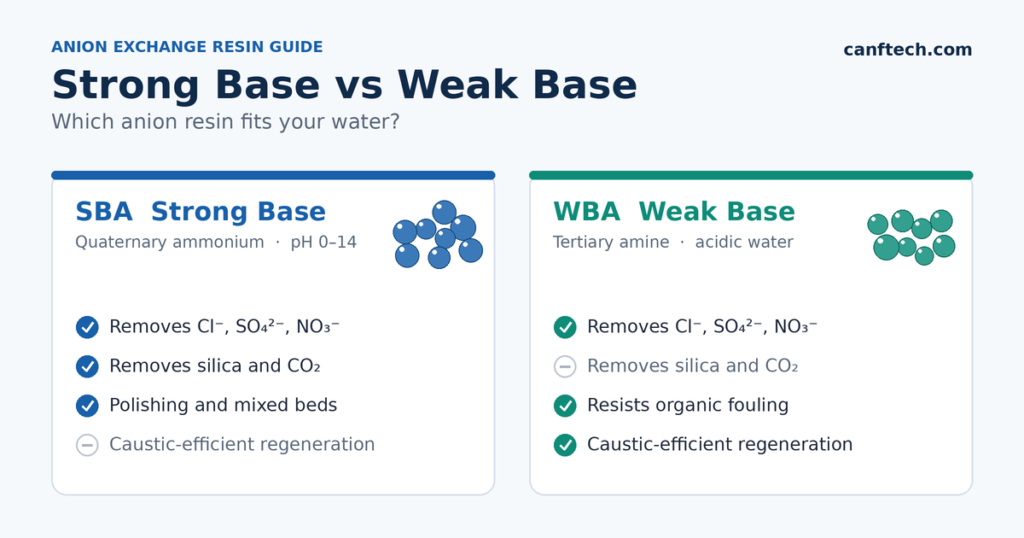
Short answer: choose a strong base anion resin (SBA) when you need to remove every anion, including weak acids such as silica and carbon dioxide, for example in demineralization and mixed beds. Choose a weak base anion resin (WBA) when you only need to remove strong mineral acids (chloride, sulfate, nitrate) and want lower caustic consumption and better resistance to organic fouling. In many demineralization plants the best answer is both: a WBA unit ahead of an SBA unit.
This guide explains how the two resin types differ, where each one fits, and how to pick the right grade for your water.
What is the difference between strong base and weak base anion resin?
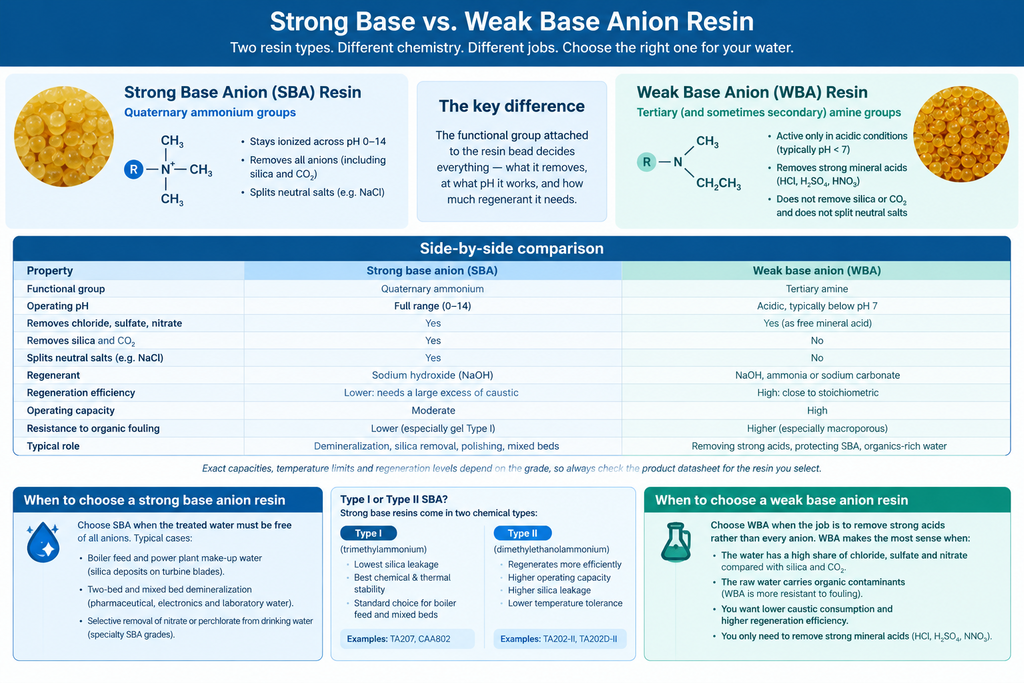
The difference is the functional group attached to the polymer bead of the ion exchange resin, and that one difference decides everything else: what the resin removes, at what pH it works, and how much regenerant it needs.
- Strong base anion (SBA) resin carries quaternary ammonium groups. They stay ionized across the whole pH range, so the resin can split neutral salts and capture weakly ionized anions such as silica (HSiO3–) and bicarbonate.
- Weak base anion (WBA) resin carries tertiary (and sometimes secondary) amine groups. They are only active in acidic conditions, so the resin absorbs free mineral acidity (HCl, H2SO4, HNO3) leaving a cation exchanger, but it cannot remove silica or CO2 and does not split neutral salts.
Side-by-side comparison
| Property | Strong base anion (SBA) | Weak base anion (WBA) |
|---|---|---|
| Functional group | Quaternary ammonium | Tertiary amine |
| Operating pH | Full range (0-14) | Acidic, typically below pH 7 |
| Removes chloride, sulfate, nitrate | Yes | Yes (as free mineral acid) |
| Removes silica and CO2 | Yes | No |
| Splits neutral salts (e.g. NaCl) | Yes | No |
| Regenerant | Sodium hydroxide (NaOH) | NaOH, ammonia or sodium carbonate |
| Regeneration efficiency | Lower: needs a large excess of caustic | High: close to stoichiometric |
| Operating capacity | Moderate | High |
| Resistance to organic fouling | Lower (especially gel Type I) | Higher (especially macroporous) |
| Typical role | Demineralization, silica removal, polishing, mixed beds | Removing strong acids, protecting SBA, organics-rich water |
Exact capacities, temperature limits and regeneration levels depend on the grade, so always check the product datasheet for the resin you select.
When to choose a strong base anion resin

Choose a strong base anion resin when the treated water must be free of all anions. Typical cases:
- Boiler feed and power plant make-up water, where silica deposits on turbine blades and must be removed.
- Two-bed and mixed bed demineralization for pharmaceutical, electronics and laboratory water.
- Selective removal of nitrate or perchlorate from drinking water, using specialty SBA grades.
Type I or Type II SBA?
Strong base resins come in two chemical types:
- Type I (trimethylammonium) gives the lowest silica leakage and the best chemical and thermal stability. It is the standard choice when silica removal is critical, for example in boiler feed water and mixed beds. Examples: TA207 high capacity gel Type I and CAA802.
- Type II (dimethylethanolammonium) regenerates more efficiently and offers higher operating capacity, at the cost of somewhat higher silica leakage and lower temperature tolerance. It suits waters where silica is not the main concern and caustic savings matter. Examples: TA202-II gel Type II and TA202D-II macroporous Type II.
When to choose a weak base anion resin

Choose a weak base anion resin when the job is to remove strong acids rather than every anion. WBA makes the most sense when:
- The water has a high share of chloride, sulfate and nitrate compared with silica and CO2. WBA takes most of the anion load at a fraction of the caustic cost.
- The raw water carries natural organic matter (humic and fulvic acids). Macroporous WBA resins absorb organics and release them during regeneration, protecting downstream SBA from irreversible fouling.
- You want to reuse spent caustic: the regenerant leaving the SBA unit still has enough strength to regenerate the WBA unit (thoroughfare regeneration).
- Silica removal is not required, for example in some process-water or acid-recovery applications.
Examples: TA301D macroporous WBA for organics-rich water and TA312 gel WBA for cleaner feeds.
Using both: the WBA + SBA train
Large demineralization plants often place a WBA unit (or a WBA layer in a stratified bed) ahead of the SBA unit. The WBA removes the strong acids and most organics; the SBA then only has to remove silica, CO2 and what slips through. The benefits:
- Lower caustic consumption, because the WBA is regenerated with caustic the SBA has already used.
- Longer SBA life, because organics are caught before they reach it.
- Higher total capacity per cycle from the same vessel volume.
A degasser between the cation and anion units further reduces the CO2 load on the SBA.
Gel or macroporous?
Both strong base anion resin and weak base anion resin grades are available in two bead structures:
- Gel resins have higher capacity and better regeneration efficiency. Use them for clean, low-organics water.
- Macroporous resins have a rigid, open pore structure that resists organic fouling and osmotic shock. Use them for surface water, water with high organics, or units with frequent regeneration. Example: TA201D macroporous Type I SBA.
For mixed beds, use a mixed bed grade with a particle size matched to the cation resin, such as TA207MB. For nitrate removal from drinking water, a nitrate-selective grade such as TA465D avoids the sulfate interference that limits standard SBA resins.
Quick selection guide
| Your situation | Recommended resin |
|---|---|
| Silica must be removed (boiler feed, mixed beds) | SBA Type I, gel or uniform particle size |
| Silica not critical, caustic cost matters | SBA Type II |
| High chloride and sulfate, low silica | WBA, or WBA ahead of SBA |
| High natural organic matter | Macroporous WBA ahead of macroporous SBA |
| Nitrate in drinking water | Nitrate-selective SBA |
| Final polishing | Mixed bed grade SBA Type I |
Need help choosing?
Canftech supplies a full range of strong base and weak base anion exchange resins, including Type I, Type II, macroporous, uniform particle size, mixed bed and selective grades. Send us your water analysis and flow rate and our team will recommend a resin and estimate the operating capacity. Request a quote.
Frequently asked questions
Can a weak base anion resin remove silica?
No. Silica is a very weak acid, and weak base amine groups are not basic enough to capture it. Silica removal requires a strong base anion resin, ideally Type I.
Why does strong base anion resin need so much caustic?
SBA resin holds anions such as chloride and sulfate strongly, so a large excess of sodium hydroxide is needed to push them off and restore the hydroxide form. WBA resin releases acids much more easily, which is why it regenerates close to stoichiometric.
What is the difference between Type I and Type II strong base resin?
Type I has trimethylammonium groups and gives lower silica leakage and better stability. Type II has dimethylethanolammonium groups and offers higher capacity and better regeneration efficiency, but slightly higher silica leakage and lower temperature tolerance.
Do I need a degasser with an SBA unit?
Not always, but a degasser removes most of the carbon dioxide formed after the cation unit. That reduces the load on the SBA resin and the caustic needed to regenerate it, which pays off at higher alkalinity.
Can WBA and SBA resins be used in the same vessel?
Yes. In a stratified or layered bed, the lighter WBA resin sits above the SBA resin in one vessel. Caustic flows through the SBA first and then the WBA, giving most of the benefits of two separate units.
How long do anion exchange resins last?
Anion resins typically last several years, but life depends on temperature, oxidants, organics and regeneration practice. Strong base resins slowly lose strong base capacity over time, so periodic resin analysis is the best way to plan replacement.